Farmgirl Fantasies
“Everybody keeps talking about this agricultural question as if it were just an economic question and farming just a business. Farming is a way of life. It is a type of civilization. Do we want to see this way of life destroyed? What will take its place?” – Gov. Frank Lowden, Illinois, 1931 |
This morning, I heard my first bird at 4:17 a.m. Meaning I was already awake and waiting for night to officially end. By the time I pulled on my pants and found a jacket, hundreds of birds were going avid. There was only a hint of light on the horizon.
I had a full day planned. Work defines farm life. And farmer time mimics bird time.
In the next three hours, I had chicken, goat and greenhouse chores. I also had a box of 1930s magazines I’d picked up at an auction, and I was itching to sit with them sometime today. I was introduced to a new neighbor last weekend at my first-ever farm auction in town (a local farmer had passed away without any next of kin taking an interest in his worldly possessions), and I wanted to go visiting.
The definition of “neighbor” in rural terms means it doesn’t take more than, say, 30 minutes by car to visit, the “neighbor” lives out in the country, and there exists some rural reason to connect. My new neighbor was about 20 minutes away, on the other side of the ridge. An investment broker turned farmer, he invited me to his place to check out his Scottish Highlander cows. A rare breed with short legs and long hair, he believes his Highlanders are perfectly suited for small farms. He’s considering organic certification, and I was once chair of the Idaho Organic Advisory Board. And I’ve been toying with the idea of getting a milk cow again, and his particular breed gives a rich milk, good for cream and butter. There’s no better way to understand people than to milk a cow twice a day. Cows need fair treatment, day after day. Good practice for working with people.
He told me how his bull had mowed down their fence recently and galloped away. He ended up coaxing him back home with day-old donuts, but it took him most of a day. “At first I called him by his name, Willie, then Sirloin, then Hamburger.” Raising animals can be a test of your patience, but I could tell he adored Willie.
“I sat among a group of railroad presidents who got to talking about the farmer. One of them was out of patience with the farmer. The farmer was a good deal of a fool, this gentleman insisted. He argued that the farmer would never get anywhere until he organized like industry, developed immense farms and ran them like a railroad or a big automobile plant.” |
Back home, I settled into a comfy chair to go through the box of old magazines I had bought at the auction.
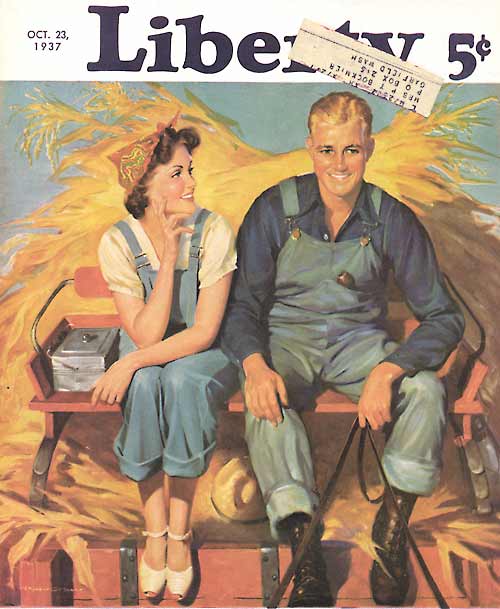
Sold originally for 5 cents, my 1931 “Country Home” byline said, “The Magazine of Home, Garden and Farm: Established 1877 as Farm & Fireside.” Some 70 years later, magazines with words like “country,” “garden” and “home” in their titles are still best sellers, but the word “farm” has been taken off the masthead.
In it, the governor of Illinois, Frank O. Lowden, who once came close to being President of the United States, had agreed to an interview to address “What’s Ahead for the Farmer?” He replied, “Last year I was in a club in Chicago. I sat among a group of railroad presidents who got to talking about the farmer. One of them was out of patience with the farmer. The farmer was a good deal of a fool, this gentleman insisted. He argued that the farmer would never get anywhere until he organized like industry, developed immense farms and ran them like a railroad or a big automobile plant.”
“Governor,” the interviewer said, “I talked with a distinguished agricultural economist last week, and he told me that the farmer’s trouble lay in the fact that, like the little grocer, the little shop craftsman, his day was about over; that the great industrialized farm, like some of those in the Southwest, had learned how to make wheat for 50 cents and even 40 cents a bushel, and that these great factoryized farms would increase and the little fellows dwindle until they had all gone and the American farm was in the hands of a number of great individual and corporate farm concerns.”
“That is something, you can be sure, that will never happen,” the governor said with such vehemence that he had to get up and walk around a little to give it emphasis. “Those that think that fail to take into account all the factors in the case.”
The governor and the interviewer turned to one of the greatest industrial financiers in America, who was at their table, and asked his opinion.
“‘Well,’ he said, ‘I have a farm. And I am a farmer. I’ve been at it a long time. I have one of those great industrialized farms. It has a huge acreage. It is in a fine farming region. I have put in all kinds of farming machinery and employed the ablest farm help and managers. I have been handicapped by no excessive farm mortgages. I have plenty of financial support back of the business. I am able to discount my bills and market my crops, I believe, intelligently. I have applied to that farm all the principles of modern scientific management which I know — and they have worked pretty successfully in my industrial business. And yet about all the use that farm has been to me financially is to help me reduce my income tax. I have lost money on it every year.’”
Governor Lowden added, “How many rich men do you know who have gone into farming and made it pay? I don’t know any, and I doubt if you do either.”
“Well, that’s the answer to the great industrialized farm. And the reason for it is plain to any farmer. The wages of helpers and managers devour the profits and they always will. The great industrialized farm can never compete with the wisely managed one-family farm where the whole family cooperates in the work, and I see nothing ahead to make me think this will change.”
“But, Governor,” the interviewer said, “there are farms which operate on a great scale and make money — what about the great wheat farms in the Southwest?
“FARMS?” he answered quizzically. “Those are not farms. Those are mines. Those fellows are not farming. They are mining. They are digging minerals out of the ground with farming tools. You know you have to count into the cost of your produce the element of depreciation. These men are farming in a semi-arid country on soil which they are forcing and they are literally devouring the fertile elements of the soil. How long will that soil last? And when the land is hopelessly worn out, it will have to be written off and the whole enterprise will have to be written off and all that investment will then have to be figured back into the cost of those crops, and they will find that the wheat has cost them a lot of money in the end.”
“But there is another side to this. The American people have got to ask themselves — do they want that kind of farm? It is a very serious and solemn question. Everybody keeps talking about this agricultural question as if it were just an economic question and farming just a business. Farming is a way of life. It is a type of civilization. Do we want to see this way of life destroyed? What will take its place?”
The interviewer asked Governor Lowden what he thought should be done for the farmer. His reply was that “the day when the intelligent farmer would come into his own was not far distant. So much is within the farmer’s reach now. The old isolation of the farm is gone. It is a place for an educated and an intelligent man to apply his mind.”
Or a woman, I thought, putting down my precious find.
And if access to land and capital has traditionally been a major limiting factor for women getting into farming, women are proving that you no longer have to be born or marry into a farm in order to farm. |
I wish Governor Lowden was still around to see the latest factor in the case. One I don’t think he factored in. I just know he’d be pleasantly surprised and supportive.
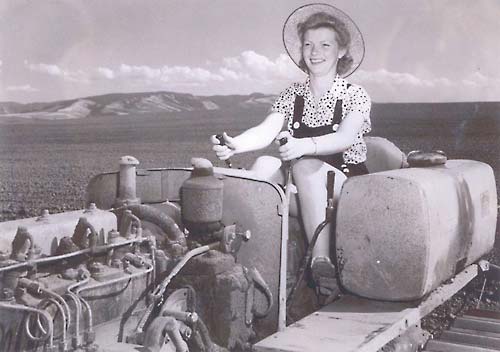
A new, unexpected breed of farmers is emerging to pick up the plow: women. But first, toss out your image of “farmer.” In some cases, we’re talking landed “Jersey Girls,” or women raised on prunes and proverbs. Even savvy authors like Barbara Kingsolver are buying small farms. Usually, these are farmgirls who remember the farm life they never led. And if access to land and capital has traditionally been a major limiting factor for women getting into farming, women are proving that you no longer have to be born or marry into a farm in order to farm.
It starts with what I call a farmgirl fantasy. Can’t you just imagine a famous therapist saying, “Our research shows that 90 percent of women experience farm fantasies.”
Mine was an obsession for almost 10 years before I found my five acres at the end of a dirt road. How did I do it? I thumbed through real estate ads as if my life depended on it. I traveled country roads knocking on doors as if I was “some kind of something.” I was undeterred and unrelenting. I hoarded my money in a can hanging from a rope lowered into a coal chute. I was bucking at the halter, so I knew I had to muster plenty of stick-to-it-ness. My place showed up one day as an ad: “Remote old homestead, five acres, orchard, well, $45,000.”
If you’re a land-poor farmgirl, have heart. We’re the fastest growing group of people buying small farms right now. Agriculture Secretary Ann Veneman said “27.2 percent of agricultural producers were women in 2002, up from 12.6 in 1997.” If you employ basic math (with extra hope thrown in), 27.2 becomes 58 percent in another five years. And a 100 in less than 10? Mary Swalla Holmes, communications coordinator with Ecumenical Ministries in Iowa, said in an interview with the Ames Tribune, “More and more agricultural land in Iowa is owned by women,” and “in particular [they] seem to be more focused on making land a legacy for the future and less focused on commodity agriculture.”
The easiest way to get started is to find a farm apprenticeship. Katherine Adam at ATTRA (www.attra.org), the USDA-funded, Arkansas-based Appropriate Technology Transfer for Rural Areas (phew!), maintains an online listing. And I’ve been bringing apprentices to my farm for eight years now, something I call Pay Dirt Farm School. My latest fantasy is something more global: training women to train women to train women. (Women in places like India are getting loans and buying small organic farms.) Now there’s an idea for a pioneering woman. My hands are full, so get yourself some land, figure out how to steward it, and then convert it to fertile training ground for future farmers. Make the fees you charge equal your mortgage payment and then some. Since land-grant colleges (originally established by the sale of Federal land for the purpose of helping train future farmers) seem to have come under contract to farm chemical companies, maybe we can reinvent that too.
Look who has the reins now.